Ottawa River Flooding: Human Error vs. Act of God? // Published on May 16, 2017
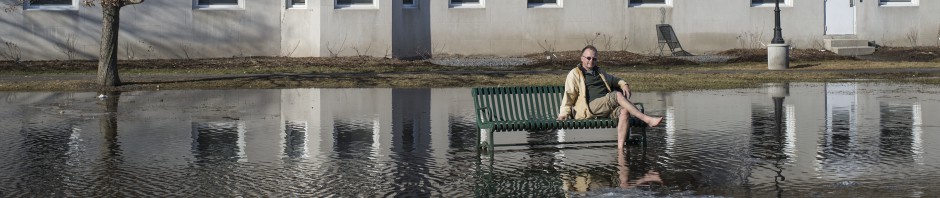
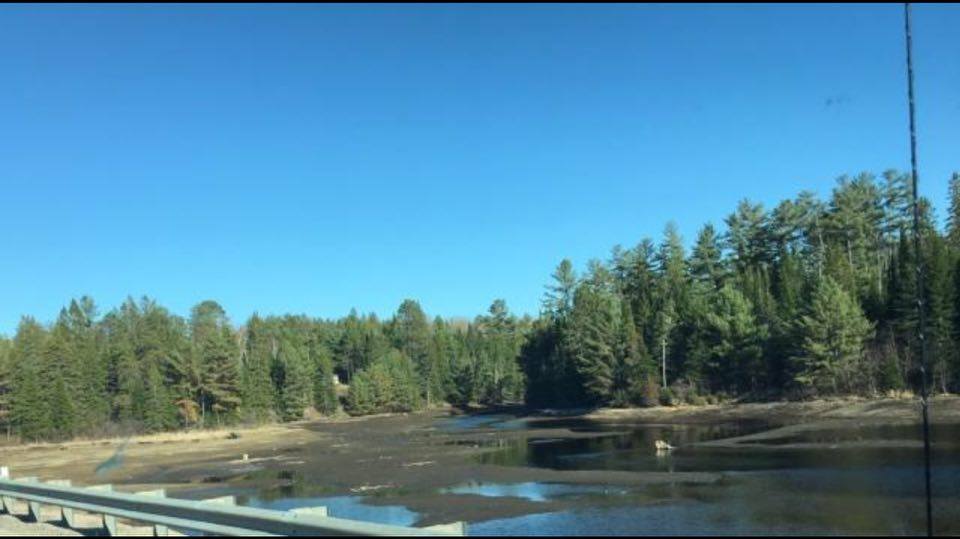
Record low water levels were reported in the Des Joachim reservoir 235 km north of the Britannia Bay water gauge in Ottawa. I estimated the volume of water in this 70 km long stretch of river (average 1 km width) for a 2.5 foot dump, which would create an estimated 3 hour long water pulse.
The Ottawa water gauge measured abrupt spikes upward on Saturday May 6th, with a rapid rise in water level of 1 cm every 5 minutes for 100 minutes, and then 1 cm every 12 minutes for 60 minutes, overwhelming river houses. The volume of water in the water spike over a subsequent 18 hours matches that in the northern reservoir between Klock & Rolphton. Hmmm…
Ottawa River Flood: Human & Natural Elements, Part 1 // Published on May 15, 2017
Whenever a “natural disaster” occurs, like the severe flooding recently in Ontario and Quebec, there are many questions. Did it have to happen? Could humans have responded differently to reduce the damage, or did the response worsen the problem?
I examine these questions and many others by looking at the geography of the river as it flows southward from northern watersheds.
———- ———-
Ottawa River Flood, Part 2 / Published on May 15, 2017
———- ———-
Ottawa River Flood. Part 3 / Published on May 15, 2017
Record Ottawa River Flooding From Climate Change // Published on May 8, 2017
In July, 2013 downtown Calgary had record flooding with insured losses exceeding $6 Billion. Three weeks later, extensive Toronto flooding from torrential rains cost more than $1 Billion.
Now it is Ottawa’s turn, along with Gatineau and Montreal and many other regions in Ontario and Quebec.
It is surprisingly simple to connect all these events, although you may not like the explanation.
———- ———-
‘We’re in a Climate Change Emergency’
Such extreme weather is much more likely now because of climate change, scientists say. As the greenhouse gas effect warms the planet, they say floods, droughts, mudslides and other extreme weather events are expected to occur more often, and with greater ferocity.
“Climate change is a global problem, but the reason we care about it is because it’s impacting us in the places where we live,” said Katharine Hayhoe, a Canadian who is the co-director of the Climate Science Center at Texas Tech University. “It’s taking these weather patterns that we’ve seen before and…putting them on steroids, so to speak.”
Paul Beckwith, who works on climatology in the Department of Geography at the University of Ottawa, also said flooding is being exacerbated by the “whiplash” of extremely wet or dry weather that is the result of climate change [Clausius-Clapeyron rate].
“We’re getting a lot more extreme weather events around the planet, whether that be torrential rains leading to flooding, or really hot and dry temperatures leading to drought,” he said.
“These extreme weather events are much more severe, much more intense, they last longer, they’re happening more frequently, and they’re happening in areas where they didn’t happen before.”
Rapidly rising water comes dangerously close on May 8, 2017 to the Chaudière Bridge near the Canadian War Museum on the Ottawa River. Photo by Alex Tétreault
He said the root cause was that the Arctic was warming faster than any other global hotspot. As white sea ice and snow cover give way to darker permafrost or open ocean, the process accelerates.
“I’ve been saying we’re in a climate change emergency, and therefore we have to respond as if it’s in an emergency,” he said.
That means eliminating fossil fuel emissions, a major driver of climate change, as a very first step, Beckwith added.
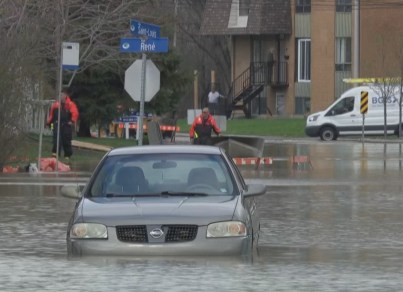
A car sits stranded in flood waters on Rue Saint-Louis in Gatineau on Tuesday, May 2. (Radio-Canada)
Here Paul was picked up by CBC Television, and has an associated podcast clip (about six minutes long) which they shared with him, and likely more to follow tomorrow, possibly nationally. There are several parts to this, and all dovetail. Simply shared thus:
“Gatineau flooding ‘tip of the iceberg,’ climate scientist warns.
And “Region received more than 3 times normal rainfall for April”.
From CBC Radio’s Ottawa Morning · CBC News, 10 Hours Ago:
“As water levels continue to rise in the national capital region, a climate scientist is warning flooding and extreme weather events are here to stay, and says homeowners should prepare.
Swollen rivers and streams have threatened hundreds of homes in the Outaouais thanks to recent heavy rainfall — three times the normal amount since April 1.
University of Ottawa climate scientist Paul Beckwith says that’s due to a changing climate, and says we’re seeing its effects “on a day-to-day basis” in weather patterns.
“What we can see is that the jet streams are behaving differently. They’re much slower, wavier, and storms are therefore moving slower. So when they’re carrying water, they’re hovering over an area longer than they would be normally, so they’re depositing more water,” Beckwith told host Hallie Cotnam on CBC Radio’s Ottawa Morning.
“Normally you think of climate change as being something that’s happening over 20 or 30 years. But what we’re seeing is the conditions on the planet are changing rapidly. So the arctic is a lot warmer than it used to be, so that’s throwing off the heat balance on the whole planet.”
‘Tip of the iceberg‘
Beckwith points to an increase in extreme weather events across North America as proof. “We’ve changed the chemistry of the atmosphere and the oceans with our greenhouse gases, so we’re seeing the consequences of this now,” he added. “It’s only the tip of the iceberg, so to speak.”
Paul Beckwith is a climate scientist with the University of Ottawa. (CBC)
Voluntary evacuations and road closures have been underway in Gatineau and other west Quebec municipalities this week due to floods. As flood water creeps closer to homes, Beckwith warns this could become more regular occurrence for people who live near rivers or in low-lying areas.
“I think in the very near future, the elevation of a house will be on the MLS [real estate] system,” he said. “So when you buy a house, you’ll know the local elevation. So houses that are on higher ground will command higher prices. Houses on lower ground — if you flood now, you’re going to flood in the future.”
“…It’s just a matter of time before it happens to just about any city the way climate change is accelerating.”
———- ———-
Despite a day of sandbagging, Ward’s Island residents may still need to evacuate.
Ferry will be kept overnight on standby at Ward’s Dock for ‘after-hours storm and temporary shelter’.
‘With Lake Ontario at its highest point in decades and with heavy rain already falling, the City of Toronto is preparing for a possible evacuation of Toronto Island Park. But its residents have spent the day laying sandbags around low-lying areas in the hope they can stay in their homes. Between 40 and 90 millimetres of rain could fall on Toronto between Thursday evening and Saturday, according to Environment Canada — a figure the weather agency increased after the storm began. Article continues in full, here.
———- ———-
Shoreline and flood worries as wind and rain hit Hamilton and region.
High water levels may lead to some shoreline flooding and beach erosion.
A flood watch is in effect for Hamilton as the city and much of southern Ontario brace for several more days of rain.
The Hamilton Conservation Authority (HCA) says this forecasted rainfall may result in further increases in water levels and flows in area watercourses, with the potential for significant flooding.
There is further concern about the potential impacts of northerly winds on the shores of Lake Ontario. Those winds may increase the risk of shoreline flooding and erosion, with Lake Ontario levels already high.
The latest rainfall — from Thursday through to Saturday — comes on top of records numbers for the year so far.
“This has been a record rainy first 125 days of a year, never has there been so much rain in that period in the Hamilton area,” said Dave Phillips, Environment Canada. Phillips says Hamilton has received about 87 per cent more rain than the city would normally get so far this year. Article continues in full, here.
——— ———- To Flood or Not to Flood; Assess YOUR Risks
Published on May 4, 2017
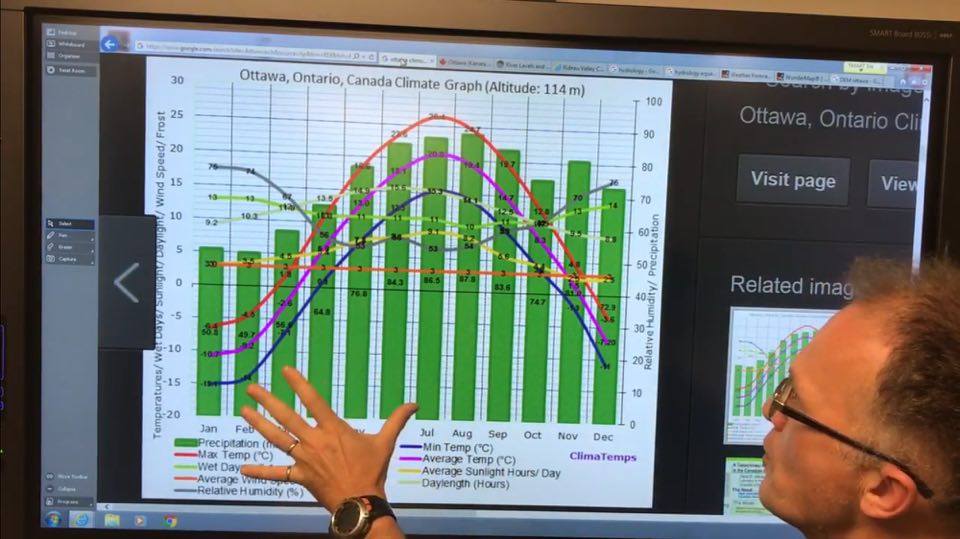
I teach you the basics of how to assess your personal risk of being flooded out of your place, either from nearby river or ocean rise or overland flooding with torrential rains.
There are some basic easy-to-use tools on the web that will let you figure out your risks. These include climographs of your region, local weather forecasts, stream and river flow gauges and forecasts, DEM (Digital Elevation Models) or detailed maps of hills and valleys in your region, types of soils, and historical data on flood occurrences, etc.
Go Paul! People’s Climate March; Emergency Call to Action // Published on Apr 29, 2017
I marched in Ottawa’s version of The People’s Climate March. In this video; in my speech to the masses rallying before the start of the march, I summarize some of the main reasons we all (You and I) need to call on the public and politicians to recognize and act with immediate haste to deal with our ongoing global climate emergency, while we still can.
I thought this showed Paul at his very best (dk). And this is after seeing or hearing two hundred or more of his videos and podcasts. When Paul is on, he is REALLY on. Shows his mastery of teaching. Followed by three similarly great videos. Four videos:
Learn to Calculate Earth’s Equilibrium Temperature // Published on Apr 25, 2017
Impress your friends. Get lots of admiration and be the star of the party. People will be lining up for your autograph, or a date…
I show you how to calculate the equilibrium temperature of the Earth.
All that you need is the Stefan-Boltzmann Equation from 1883 and some information on the surface area of a sphere.
———- ———-
Accelerating Effects of Arctic Feedback: 1 of 2 // Published on Apr 25, 2017
For years, my climate scientist hero has been James Hansen. More recently, Peter Wadhams from Cambridge in the U.K. has become a hero-among-equals with Hansen, especially with his brilliant book“A Farewell To Ice“, of which he sent me an autographed copy.
I discuss numerous feedbacks turning the Arctic icebox into a frigging sauna-on-steroids; including some that Peter does not cover.
———- ———-
Accelerating Effects of Arctic Feedbacks: 2 of 2 // Published on Apr 27, 2017
There are numerous powerful amplifying feedbacks in the Arctic, causing the temperatures there to skyrocket. This has profound implications to humanity, including enormous threats to our global food and fresh water supplies.
———- ———-
Arctic Methane: A Catastrophe in the Making // Published on Apr 28, 2017
Up to 2005, the oceans over the shallow continental shelves in the Russian Arctic (ESAS, Laptev) were ice covered, keeping the -100 meter deep oceans near freezing temperatures.
Since 2005, the ice cap cover has gone. The water has warmed as high as 17 degrees C there in summer, heating the sea-floor, perforating the permafrost cap, and thawing methane hydrates. Ebullition (bubbling methane) is rising up the water into the atmosphere in ever increasing amounts.
———- ———-
Please support my videos and website with a contribution, at this easy to use Donate feature. Does not require a PayPal account. Thank you.
‘Massive flooding in Windsor last year was a sign of climate change — but the science behind these ever-intensifying storms is more complex than it seems’ …
The Ontario Educational Communications Authority (TVO) profiled Paul, further down page, here:
‘The Changing jet stream
Cyclonic storms are moved by air currents called jet streams. The currents in Ontario are created when cold air from the north collides with warm air from the south.
“The jet stream or winds in the mid-levels of the atmosphere help guide low pressure systems as they move across North America,” says Geoff Coulson, an Environment Canada climatologist. “Every once in a while the winds in the mid-level of atmosphere will slacken off and will be in an area where there isn’t much push. This low-pressure system basically sat in that area to the south of Windsor and kept pumping moisture.”
Both poles are heating up faster than the equator is, and that’s contorting the jet stream, lowering its speed and increasing its waviness — it typically travels east-west, but waviness makes it travel north-south sometimes.
The Arctic is warming faster, Beckwith explains, because as the sea ice melts, it exposes more ocean. Since the ocean is darker than ice, it absorbs more heat — which causes more ice to melt, which exposes still more dark surfaces. Similarly, less snow cover on land exposes more dark ground.
“There are more and more examples occurring all around the world of these torrential rain events where a region or a city will get four to five months of rainfall and they get it in a night or they get it in a couple days,” Beckwith says. “And that leads to flooding because the infrastructure just can’t handle it.”
The changing jet streams have influenced not just storms but other catastrophic weather events too, Beckwith says. The European heat wave of 2003, the 2010 Russian drought, and the recent California drought were all caused by jet-stream oddities.
Beckwith says storms like that in Windsor are going to keep happening as the temperature difference between the poles and the equator continues to shrink. “We’re heading rapidly to an arctic with less sea ice and much less snow cover,” he explains. “The extreme weather events that we’re seeing will get much worse.”’
———- ———-
And Paul’s third recent video, in series: Abrupt Climate Changes in Global Atmospheric Circulation // Published on Apr 13, 2017
How is ABRUPT CLIMATE CHANGE presently shifting our global atmospheric circulation patterns? We know jet streams are slower & wavier, greatly increasing the frequency, severity & duration of extreme weather events (flooding, droughts, with intensified risk to global food supply).
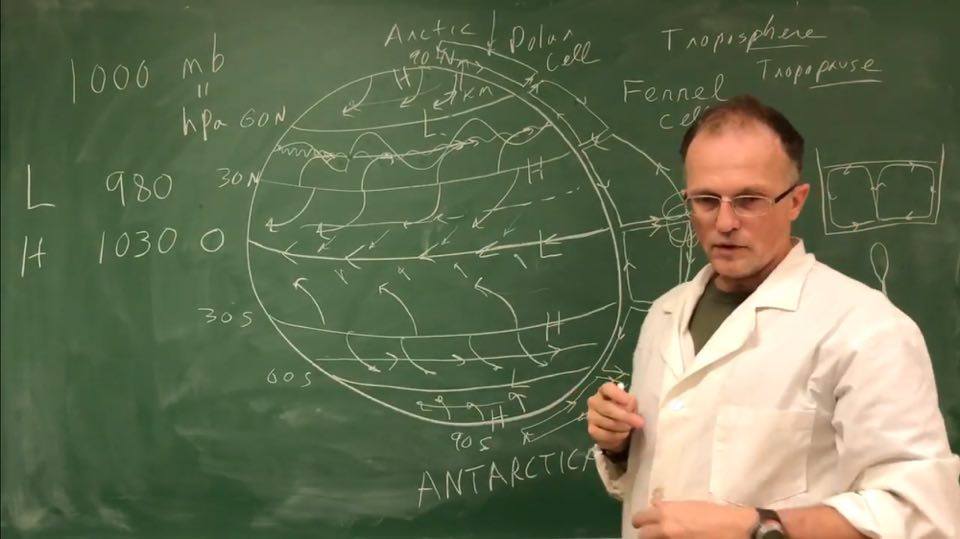
Will the present 3-cell behaviour (Hadley, Ferrel, Polar) mutate to a 2-cell or 1-cell pattern? Will there even be a jet stream?
Earth’s Largest Living Structure IS Dying: 1 of 2 // Published on Apr 10, 2017
Australia’s Great Barrier Reef is an enormous tourist attraction that pumps billions of tourism dollars each year into the economy. Very soon, this revenue that is so vital to Australia’s financial security will have to be replaced by giving tours of coal mines.
The loss of these reefs is occurring as we speak. Back-to-back record bleachings in 2017 and 2016 are massacring this vital “Amazon Forest of the Oceans”. How will fish live?
———- ———-
Earth’s Largest Living Structure IS Dying: 2 of 2 // Published on Apr 11, 2017
Australia’s Great Barrier Reef is a wonder of the world. Attracting millions of tourists and pumping billions of dollars into Australia’s economy, this reef is bleaching white, becoming covered in slimy algae, and will inevitably be ground to sand. A tragedy.
I discuss the facts on the ground, or in this case on the shallow seabed.
Understanding Atmospheric Circulation Patterns // Published on Apr 10, 2017
I teach you how (the layperson, or not) to draw the atmospheric circulation patterns of the Earth. All you need to know is that “hot air rises”, there are 3 main cells, and moving objects north of the equator turn to the right (opposite in the south).
With this knowledge in your “toolkit”, you can better understand how the jet streams form, and how they change as the Arctic rapidly warms.
———- ———-
Patterns in Global Ocean Currents & Changes // Published on Apr 12, 2017
Draw a MAP of Earth from memory. Practice until it is somewhat recognizable. On this map, I teach you how to draw the ocean currents around the planet, including surface water flows and seafloor flows.
All you need to remember is that movement is deflected to the right in the northern hemisphere; opposite in the south. Also, that the Gulf Stream flows NE off the US east coast. Everything else flows naturally, including the location of the 5 main ocean gyres. I discuss how climate is changing these patterns.
———- ———-
Jet Stream Shift 17 degrees Southward to Greenland
Summary
Well known and respected creator of entertaining and comprehensible videos of sometimes daunting subjects, especially in climate system science, meteorology, oceanography and Earth Sciences at YouTube.
Frequently called upon for commentary by fellow educators, activists, and public. Physicist, Engineer, and part-time professor at the University of Ottawa. His primary interest is joining-the-dots on Abrupt Climate System Change to determine where we are heading, and how fast, and what it all means for us and our amazing planet.









 Paul Beckwith, Climate System Scientist